
An honorary decree from Susa?
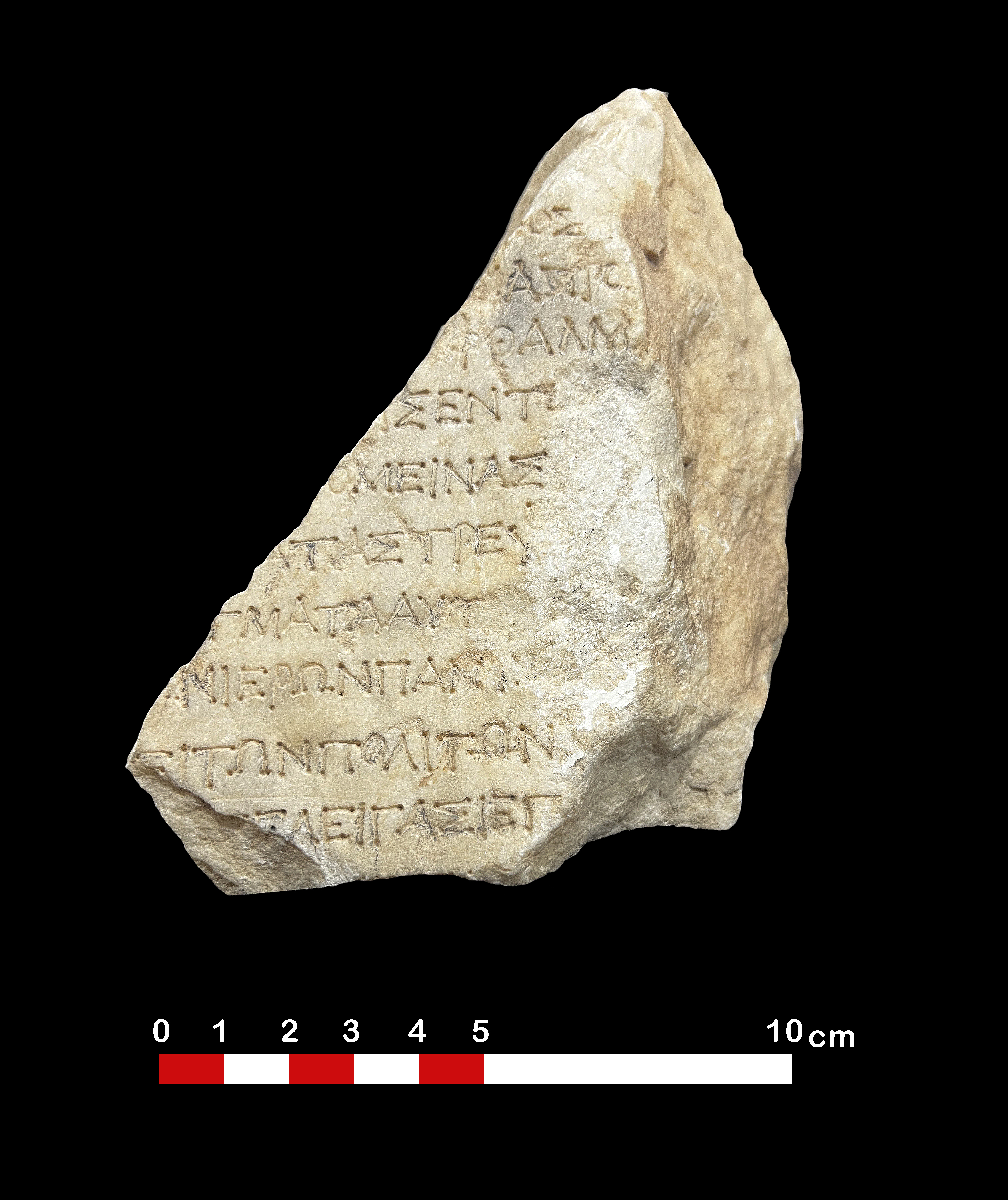
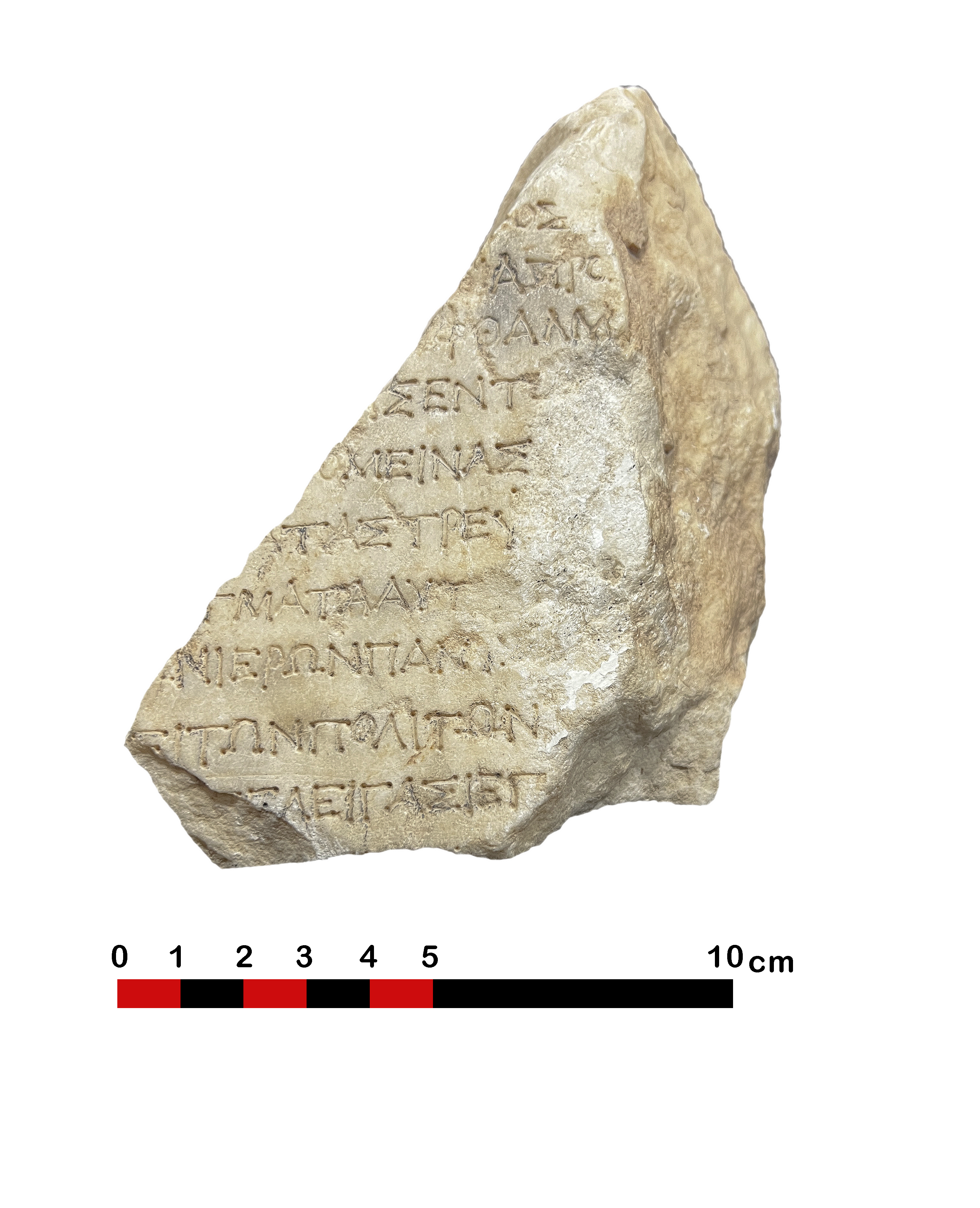
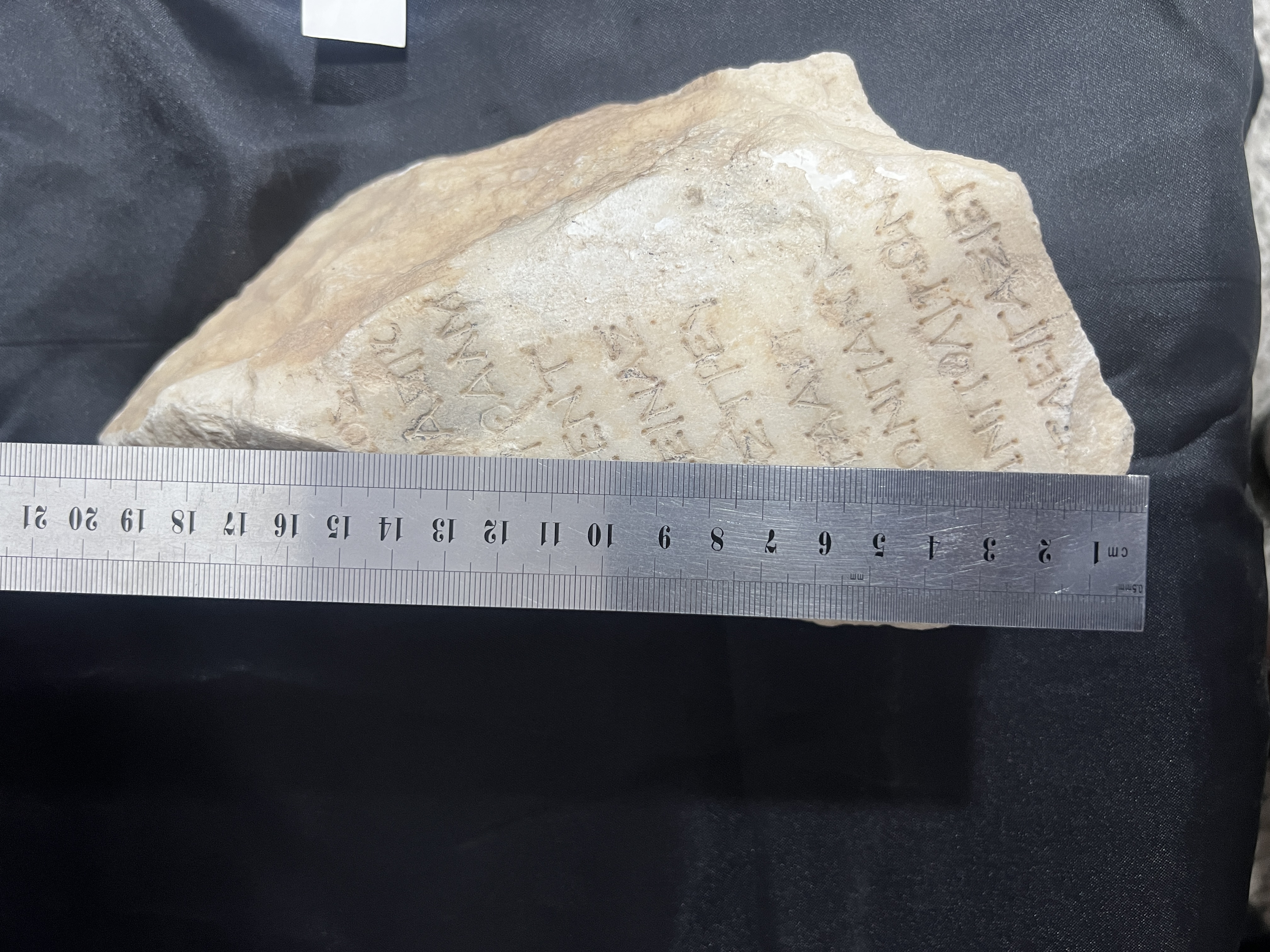
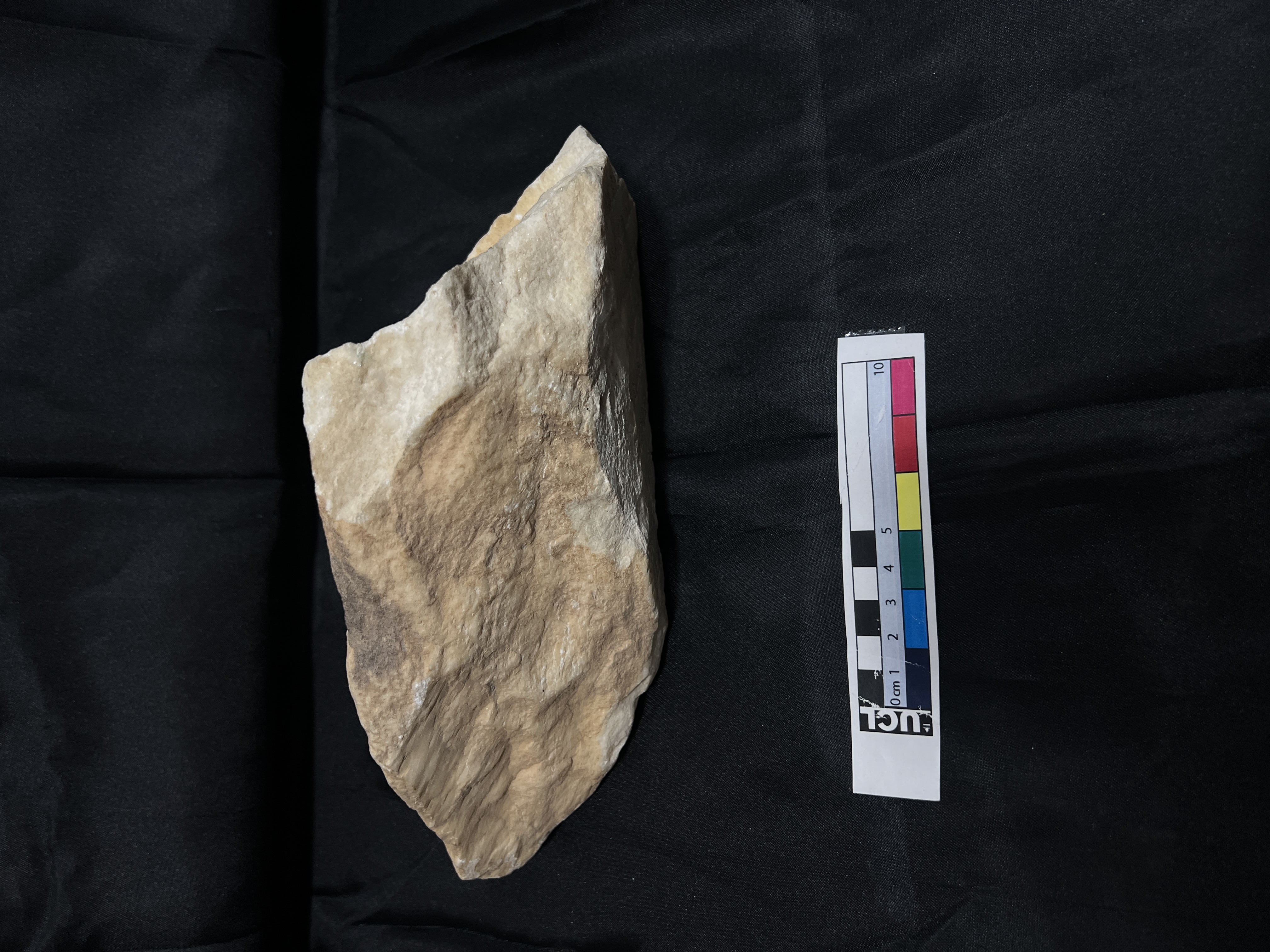
Inscription
| [- - - - - - - - - - - - - - - - - - - - - - - - - - - - - -] | |
| 1 | [- - - - - - - - - - - - - -- - - - - -]ΟΣ[- - - - - - - - - -] |
| [- - - - - - - - - - - - - - - - - -]MΑΠΡΟΣ ̣[- - - - - - -] | |
| [- - - - - - - - -- - - - - πρὸ ὀ]φθαλμ[ῶν - - - - - - -] | |
| 4 | [ - - - - - - - - - - - - - - - -]Ι̣ΣΕΝΤΩ[- - - - - - - - - - -] |
| [- - - - - - - - - - - - - ὑπ]ομείνας [ - - - - - - - - - - -] | |
| [- - - - - - - - - - - - - κ]αταστρεψ[άμενος vel sim.] | |
| [- - - - - - - τὰ πρά]γ̣ματα αὐτ[οῦ or αὐτῶν - - ] | |
| 8 | [- - - - - - - - - τ]ῶν ἱερῶν πάντω̣[ν- - - - - - - - -] |
| [- - - - - - - - - - - -]ει τῶν πολιτῶν [- - - - - - - -] | |
| [- - - - - - - - - - τοῖς] π̣ελειγᾶσι ΕΠ̣[- - - - - - - - -] | |
| [- - - - - - - - - ca. 3-4 drill holes - - - - - - - - - ] |
Inscription Credits
[.] in full view (or before the eyes [of all]) […] having accepted (or having borne, e.g., an expense, function, burden) […] having brought under submission(?) […] in regard to his (or their) affairs […] of all the sanctuaries […] of the citizens […] to the peliganes […]
Comment
The inscribed fragment was discovered in 1998 during bulldozer earthworks, which were undertaken to level the ground for agricultural development, approximately one hundred meters north of the northern defensive wall of the Sasanian city (Ērān-xwarrah-Šābūhr-šahrestān) that once stood at the site presently known as Ayvān-e Karḵa, 17 km, as the crow flies, northwest of Susa. The stone was subsequently recovered by the archaeological authorities and deposited in the Susa Museum (M. Rahbar’s written communication to R. Boucharlat, March 2010, cited in Rougemont 2012b: 24). Mehdi Rahbar (2008: 370) first published a low-resolution photograph and a facsimile of the inscription. These formed the basis of the editions of the text by Georges Rougemont (2012b: 24-27 [SEG 59 (2009) 1654]) and Pierre-Louis Gatier (2013 [SEG 59 (2009) 1654]). The present edition is based on an examination of high-resolution photographs, which have made it possible to improve and clarify earlier readings of this document.
As Rougemont deduced, we are dealing with a document —possibly a civic honorary decree inscribed on a stele— whose letter forms point to the Hellenistic period and ‘would be quite fitting for the second century BC’ (see also below). On the other hand, the Sasanian city at Ayvān-e Karḵa was founded by Šāhpūhr II (AD 309-379) after he destroyed Susa, and there are no other known traces of ancient activity at that site before the first two centuries of our era (cf. Rougemont 2012b: 24 and n. 102). On these grounds, it can be stated with some confidence that the inscription was not composed at Ayvān-e Karḵa. Susa, the closest known locality of Greek-Macedonian settlement, and a site that has also produced a number of Hellenistic inscriptions, poses as the most probable place of origin of the inscribed fragment. When Šāhpūhr II destroyed Susa in the fourth century AD, the stele —or what remained of it— must have been transported to the site of the new Sasanian settlement, which was populated by Susa deportees, to be reused as building material (Rougemont 2012b: 27 and n. 105; Gatier 2013: 207 and n. 11).
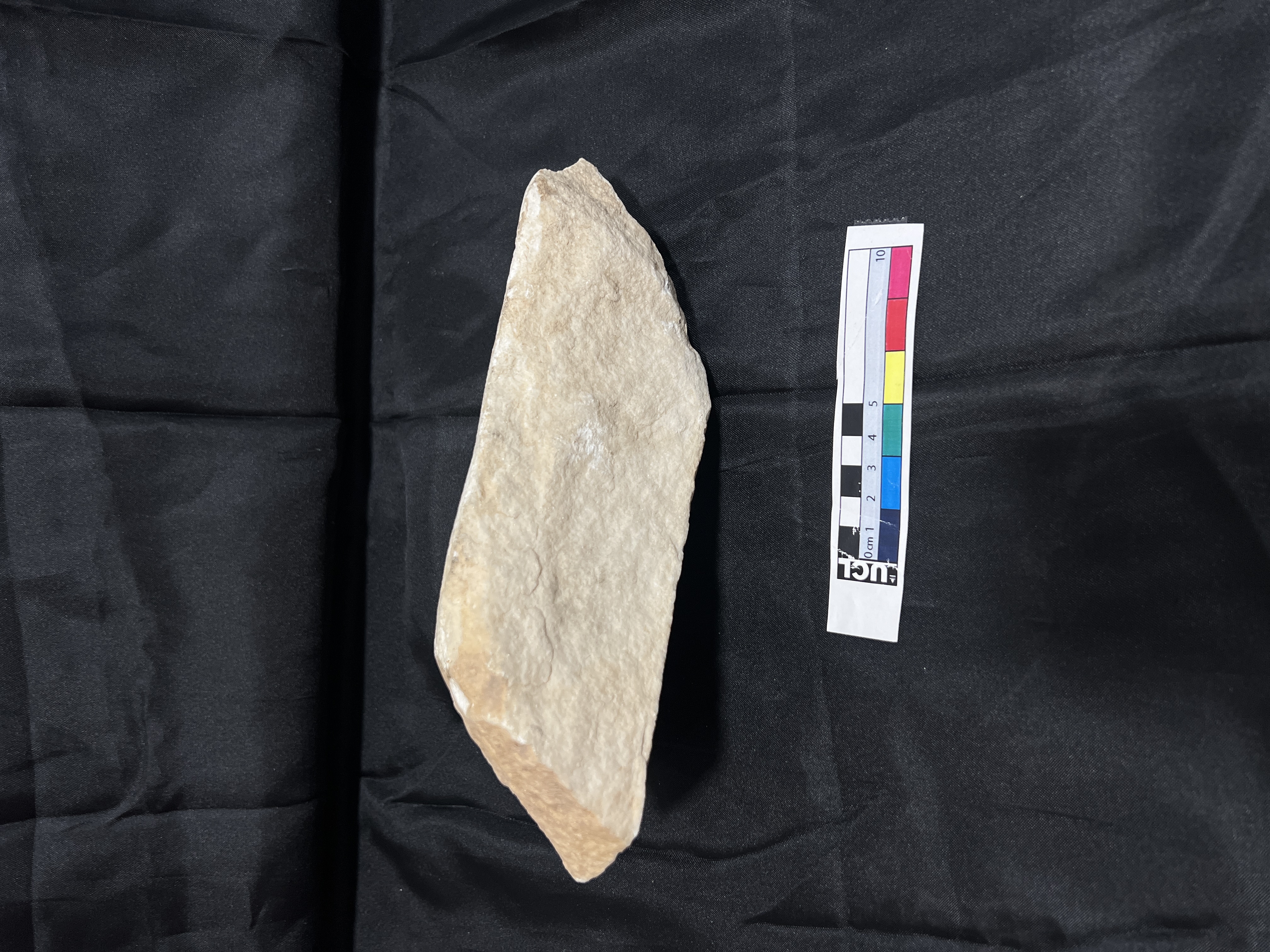
The stone is broken on all sides, making it impossible to determine the original extent of the inscription, which may have been considerable. At least ten lines of fragmentary text are preserved. The drill holes at the extremities of the letters are clearly visible in the recent photographs.
In line 2, before A, the two drill holes, marking the ends of a vertical (or perhaps a slightly slanted) stroke and a possible third hole further left, at the base of the letters of the line, could belong to a M (compare M in l. 5); the drill hole and traces of a letter after O may correspond to the lower left part of a sigma. — In line 3, one may read, with Rougemont, [ὀ]φθαλμ[---]. — In line 4, the vertical stroke before the Σ could belong to an iota, as Rougemont suggested; at the end of the line, the drill hole to the right of T likely represents the now-lost end of the left stroke of an omega (cf. l. 8). Gatier (pp. 208-209) proposed the following hypotheses for restoration: [ἐκόμ]ι̣σεν τῷ [δήμῳ], ‘presented (a proposal) to the people’ or [ἐβοήθ]η̣σεν τῷ [δήμῳ], ‘came to the aid of the people’. — In line 5, one may read, as proposed by both Rougemont and Gatier, a form of ὑπομένω; Rougemont: [ὑπ]ομείνας(?). — At the end of line 6, the trace of the vertical stroke of a psi is more clearly visible in the recent photographs, and supports Gatier’s reading κ]α̣ταστρεψ̣[---], in place of the first editor’s [---]Α̣ΤΑΣΤΡΕΥ̣[---]. — In line 7, Gatier supplements [τὰ πρά]γ̣ματα αὐτ[οῦ or αὐτῶν] for Rougemont’s [---]γ̣ματα αὐτ̣[---]. Another possible alternative might be [---προστά]γματα αὐτ[οῦ or αὐτῶν], that is, a reference to ordinances previously issued by one or more individuals (see e.g. IG II3 1, 1258, ll. 45-46; Pippidi 1983: no. 15, l. 29 [PHI]). — In the beginning of line 8, the two closely placed drill holes that are visible before the N in one of the recent photographs support Rougemont’s restoration of an omega ([τ]ῶν ἱερῶν πάντω[ν]); the position of the single drill hole at the end of the line may suggest the former presence of another omega, as it occupies the same elevated position as the visible omega on the same line and, for instance, the omega in line 9. — In line 9, Rougemont had proposed [---]σ?ι (or ε?ι) τῶν πολιτῶν, cf. Gatier’s tentative proposition τοῖς ἐντυγχάνουσι τῶν πολιτῶν. Based on one of the recent photographs, an epsilon seems more likely than a sigma. — In line 10, to the left of Λ, one can also more clearly discern the upper half of an epsilon and, before it, a trace that might belong to a pi, lending further credence to Gatier’s reading [π]ε̣λειγᾶσι. — All that remains of the letters in line 11 are two drill holes below the ΙΓ and one or, possibly, two more drill holes below the Σ of line 10.
From a paleographic standpoint, the letters display numerous similarities with epigraphic documents from the Hellenistic East but do not enable close dating. According to Rougemont, the writing ‘would be very appropriate for the second century BC’. Thinking of Susa as the probable provenance of the inscribed fragment, he further noted that those of the Susa inscriptions ‘that can be dated with the greatest certainty date from the first three quarters of the second century, and most of those that cannot be dated with certainty can easily be placed within the same chronological period’ (Rougemont 2012b: 26-27; compare Rougemont 2012a: no. 13 of 183/2 BC; no. 20 of the late third - early second century BC; no. 5, datable to the late third or second, or even first(?), century BC). Gatier (2013: 210) opted for the first half of the second century BC. Taking into account the presence of alphas with a straight bar and sigmas with parallel outer strokes, a date between the last quarter of the third century and the early decades of the second century BC can also be proposed (compare, e.g., Rougemont 2012a: nos. 20 and 21, dated to the late third - early second century BC), that is, within the Seleucid period. Or, should one allow for a broader range in the second century BC, the possibility that the text was drafted in the early Parthian period cannot be ruled out, either.
Despite its fragmentary state, the document is of considerable interest. As the previous editors noted, certain vocabulary and expressions are typical of honorary inscriptions (Rougemont 2012b: 27, and Gatier 2013: 208-209, with parallels). Thus, Rougemont’s proposed restoration [πρὸ ὀ]φθαλμ[ῶν] (l. 3) could refer to a situation of evident danger or difficulty faced by a city, which was then resolved by a benefactor, as in the decree of Olbia for Protogenes (Latyshev 1916: no. 32, face B, ll. 23-24, ca. 230 BC? or late third - early second century BC? [PHI] and the decree of Apollonia Salbace for Pamphilus (Robert 1954: no. 167, ll. 5-7, after 188 BC [PHI]). Alternatively, this expression could apply to an honorand who acted with the public good in mind, as in the decree of Priene for Moschion (Blümel et al. 2014: no. 64, ll. 64–65, after 129 BC [PHI]). The term ὑπομείνας (l. 5) also frequently appears in honorary inscriptions to indicate that the honoree incurred an expense, or assumed a function or burden for the benefit of the community (e.g., IG II³ 1, 911, ll. 79-80, SEG 30 [1980] 546, ll. 25-26 [AIO] [PHI]; Robert 1983: no. 20, l. 9; IG XII 4, 1, 110, l. 3, and SEG 54 [2004] 1353, l. 30).
In line 6, the verb καταστρέφω (LSJ9 s.v. καταστρέφω ‘to destroy’ or, in the middle voice,‘to sack’, ‘to subdue’) is in the aorist tense rather than the future tense, if the text indeed focuses on past events. The absence of the augment rules out an indicative form of the verb. Although the subjunctive and optative cannot be excluded, the more likely option is an infinitive (καταστρέψαι or καταστρέψασθαι) or, preferably, the more frequently attested middle participle καταστρεψάμενος in the nominative or one of the other cases (cf. Gatier 2013: 209). As pointed out by Gatier, the following line, τὰ πρά]γ̣ματα αὐτ[οῦ or αὐτῶν], recalls a standard Hellenistic chancery usage of τὰ πράγματα (LSJ9 s.v. πρᾶγμα) with reference to the ‘realm’, ‘affairs’ or ‘interests’ of a ruler. This restoration rules out, nonetheless, the possibility of a royal letter —which one might contemplate in the case of a (royal) chancery document— since the third-person personal pronoun would not have been used in that case (Gatier 2013: 209). The document could be instead a civic decree honoring an individual, possibly a fellow citizen or even a ruler. In the latter case, lines 6 and 7 could allude to a successful military campaign that enabled the ruler (or rulers) in question to restore or increase their power —an item that is equally encountered among the circumstances that motivated the bestowal of honors in civic decrees (e.g., the decree of Ilion for Antiochus I or III [PHI], Ma 1999: 254-259). The uncertain chronology of the inscription does not permit definitive conclusions. Should a date in the late third or early second century BC be viable, however, one might hypothetically consider Antiochus III (r. 222-187 BC), who re-established Seleucid authority in the region after Molon's revolt (222-220 BC; Plb. 5.40-55), and whose subsequent expedition to the Upper Satrapies may have also affected the area of Susa (212-205 BC, see Martinez-Sève 2013; Coloru 2024). Nor can one entirely exclude the possibility that the text refers to events connected with the ill-fated anabasis of Antiochus IV (r. 175-164 BC) through Armenia, Elymais, Persis, and the Persian Gulf in 165-164 BC (see, e.g., 1 Maccabees 3.31-37, 6.1-16; 2 Maccabees 1.13-17, 9.1-29; Plb. 31.11; Diod. 31.17a; App. Syr. 8.45, 11.66; J. AJ 12.354-359; Mittag 2006; Martinez-Sève 2014). Be that as it may, it is difficult to ascertain whether the inscription might refer to a wealthy citizen with potential royal connections who acted during a period of conflict (perhaps as ambassador sent to the king, as Gatier suggested?), or if the ruler himself assisted the city during this critical phase.
Although the restoration [τ]ῶν ἱερῶν πάντω̣[ν] ‘of all the sanctuaries’ (of the city? of the region?) in line 8 seems certain, the fragmentary condition of the text prevents us from determining whether this expression refers to a function or office or to the locations where the honors for the recipient were to be celebrated. If the reference is to a function or office, one may think of priests ‘of all the temples’ or a royal functionary, that is, an archiereus ‘chief priest’ in charge ‘of all the sanctuaries’ (Rougemont 2012b: 27; Gatier 2013: 209; see also the mention of an archiereus at Susa on a fragmentary limestone plaque, Rougemont 2012a: no. 28, dated to the third or early second century BC). This individual may have been the provincial official responsible for the Seleucid dynastic cult; however, the possibility that he served as the priest of the civic ruler cult cannot be excluded (for ruler cult in Seleucid Iran, see the copies of an edict of Antiochus III found in Nehāvand and Kermānšāh, Rougemont 2012a: nos. 66 and 68, respectively; and the decree emanating from Antioch in Persis, for which see now Rougemont 2012a: no. 53, ll. 2-6). Alternatively, [τ]ῶν ἱερῶν πάντω̣[ν] could denote the locations where the honors for the recipient were to be celebrated, as in the thanksgiving of Telmessos after a victory of Eumenes against the Galatian Ortiagon in 184/3 BC (Maiuri 1932: no. 172,3, ll. 17-18 [PHI]).
Lines 9-10 are particularly significant, as they contain references to individuals who were part of the civic body and the administrative apparatus. The mention of politai ‘citizens’ (l. 9: τῶν πολιτῶν) constitutes the third piece of evidence currently available (see also Rougemont 2012a: nos. 3 and 21) that the ancient Achaemenid center of Susa had been reorganized, at least in part, as a polis (i.e., a city with Greek institutions) in the Hellenistic period; more probably, from the mid-third century BC onward (Martinez-Sève 2013), when Media and Persis became de facto the easternmost border of the Seleucid Upper Satrapies after the loss of Parthia and Bactria (Coloru 2023: 207-214). The lacuna may have contained expressions evoking the honorand’s constant willingness to assist the citizens, e.g., ἀεὶ τῶν πολιτῶν παρέχεται χρείας ἐν παντὶ καιρῶι ‘he consistently places himself at the service of the citizens in every circumstance’ (Petrakos 1997: no. 67, l. 2 [PHI], and no. 68, l. 3 [PHI), or εἰς ὃ ἄν τις αὐτὸν παρακαλεῖ τῶν πολιτῶν ‘for whatever purpose any of the citizens may call upon him’ (e.g., Petrakos 1999: no. 59, ll. 9-10 [PHI]; for another possible context of the reference to politai, see Maiuri 1932: no. 172,3, l. 22 [PHI]).
Even more noteworthy is the mention of the peliganes, correctly identified by Gatier in line 10 (dative plural πελειγᾶσι [cf. Coloru 2013: 41-42, Nawotka 2023: 387]), who tentatively proposed restoring a resolution formula of a decree, such as [δεδόχθαι τοῖς π]ε̣λειγᾶσι ἐπ[αινέσαι] ‘it has been decided by the peliganes to praise’.
The term peliganes draws our attention, in particular, to the role played by the Macedonian element and Macedonian political institutions in the Greek settlements founded in the East during the Alexandrine-Seleucid period. As Gatier recalled, Pierre Roussel (1942-1943) first emphasized the distinctly Macedonian character of this body, based on references to it in a decree of the peliganes (πελιγᾶσιν) of Laodicea by the Sea from 174 BC (Jalabert and Mouterde 1955: no. 1261, l. 22 [PHI]; Sosin 2025: l. 22) and a passage of Polybius that refers to Seleucia on the Tigris in 220 BC (Plb. 5.54.10, with Roussel’s emendation of the corrupted form Ἀδειγάνας to πελιγάνας) — both of these cities founded by the Seleucids. He further recalled that confirmation of its existence in Macedonia itself is provided by an inscription recording a letter of Philip V to the city of Dion, addressed to ‘the epistatēs of the Diastes, the peliganes (τοῖς πελειγᾶσι) and the other citizens (τοῖς λοιποῖς πολίταις)’ in ca. 180 BC (Hatzopoulos 1998: 1195-1196, [PHI]; for further bibliography on the Macedonian context, see Mari 2018: 188 n. 46).
In Babylon the same body is attested by cuneiform documents of the Parthian period (Spek et al. 2025: Diaries -125A: [18] and -81: 6΄, and undated diary BM 335189+, BM 35229+ ['Bagayasha Chronicle’, ca. 138-127/6 BC?]: B3΄). These Babylonian documents mention both peliganes (Akk. peliganānu) and politai (Akk. puliṭānu, presumably Greek or Hellenized citizens; see, e.g., Coloru 2013: 45; Bousdroukis 2025: 680-684) and, in one instance, clearly indicate that the peliganes were a body consisting of politai (Spek et al. 2025: Diary -81: 6΄: ‘the politai who are called peliga[nes]’, Mitsuma 2019: 301-304).
There is no information on how the peliganes were appointed, and the nature of their functions remains debated. As different scholars variously suggested, they may have been members of the boulē (see esp. Hatzopoulos 1998: 1196, and, more recently, idem 2020: 101 [‘the permanent commission of the assembly’]) or city officials responsible for civic and political administration on behalf of the king (Sarakinski 2010). Or, they may have formed a collegiate body that cannot be equated with a boulē functioning as a committee of a clearly attested dēmos (‘people’/‘citizen body’), but which was instead a council of leading figures or gerousia ‘elders’ (Strab. 7.fragments.2), whose composition and role find a closer parallel in the Roman Senate of the Early Imperial period (Nawotka 2023). According to Hesychius of Alexandria (s.v. πελιγᾶνες) the peliganes are ‘those who hold honour; among the Syrians, councillors (bouleutai)’. The term Syrians should here be understood as referring to the Seleucids, who were commonly designated ‘kings of Syria’ (for a discussion of the historical significance of this designation, see Coloru 2021). This constitutes further evidence for the persistence of Macedonian institutions within the Seleucid kingdom. Manuela Mari (2018: 188 n. 46) has argued that the clear distinction drawn between the peliganes and the archontes in the textual evidence, together with the definitions provided by Strabo and Hesychius, indicates that the peliganes were not civil magistrates entrusted with the administration of civic affairs.
Bibliography
AIO = Attic Inscriptions Online. Available at https://www.atticinscriptions.com/
Appian, Syrian Wars (App. Syr.) = White, H. (ed. & trans.) 1899. The Roman History of Appian of Alexandria, vol. I: The Foreign Wars. New York. Also made available online by Perseus Digital Library at http://data.perseus.org/citations/urn:cts:greekLit:tlg0551.tlg013.perseus-eng1:1
Blümel, W., Merkelbach, R. and Rumscheid, F. 2014. Die Inschriften von Priene. Inschriften griechischer Städte aus Kleinasien 69. Bonn.
Bousdroukis, A. 2025. D’Alexandre à Kanishka: Interactions culturelles dans les fondations des successeurs d’Alexandre, du Proche-Orient à la vallée de l’Indus, aux époques hellénistique, romaine et arsacide, 2 vols. Mémoires de la Délégation archéologique française en Afghanistan 35. Athens.
Coloru, O. 2013. ‘Seleukid settlements: between ethnic identity and mobility.’ Electrum 20: 37-56. Also available online at https://ejournals.eu/en/journal/electrum/article/seleukid-settlements-between-ethnic-identity-and-mobility
——. 2018. ‘The delegation to Seleucos II at Baiseira: a brief note.’ Electrum 25: 9-12. Also available online at https://doi.org/10.4467/20800909EL.18.001.8921
——. 2021. ‘Les Séleucides: rois d'Asie, rois de Syrie: évolution d'un concept géopolitique dans les dernières phases de l'histoire séleucide.’ In Feyel, Ch. and Graslin-Thomé, L. (eds.), Les derniers Séleucides et leur territoire. Paris: 37-50.
——. 2023. ‘Seen from Ecbatana: aspects of Seleucid policy in Media.’ In Daryaee, T., Rollinger, R. and Canepa, M. P. (eds.), Iran and the Transformation of Ancient Near Eastern History: The Seleucids (ca. 312–150 BCE). Wiesbaden: 201-216.
——. 2024. ‘Antiochos III: soft power in war and diplomacy.’ Politica Antica 14: 41-54.
Diodorus Siculus (Diod.) = Walton, F. R. (trans./ed.) 1957. Diodorus of Sicily in Twelve Volumes, vol. 11: Fragments of Books XXI – XXXII. Cambridge, MA, and London.
Gatier, P.-L. 2013. ‘Des péliganes à Suse.’ Zeitschrift für Papyrologie und Epigraphik 184: 205-210. Also available online at https://www.jstor.org/stable/23849935
Hatzopoulos, M. 1998. ‘Épigraphie et philologie: récentes découvertes épigraphiques et gloses macédoniennes d’Hésychius.’ Comptes rendus des séances de l'Académie des Inscriptions et Belles-Lettres 142/4: 1189-1218. Also available online at https://doi.org/10.3406/crai.1998.15952
——. 2020. Ancient Macedonia. Berlin and Boston.
Hesychius of Alexandria = Hansen, P. A. (ed.) 2005. Hesychii Alexandrini lexicon. Volumen III [Pi – Sigma]. Berlin-Boston. Also available online at https://archive.org/details/PeterAllanHansenEditorHesychiiAlexandriniLEXICON2005/mode/2up
IG = Inscriptiones graecae. Berlin 1873 -. Available online at https://telota.bbaw.de/ig/
Jalabert, L. and Mouterde, R. 1955. Inscriptions grecques et latines de la Syrie, vol. IV: Laodicée, Apamène. Paris. Also available online at www.persee.fr/doc/bah_0768-2506_1955_cat_61_41
Flavius Josephus, Antiquities of the Jews (J. AJ) = Whiston, W. (trans.) 1857. The Works of Flavius Josephus. Auburn and Buffalo. Also made available online by Perseus Digital Library at http://data.perseus.org/citations/urn:cts:greekLit:tlg0526.tlg001.perseus-eng1:1.1
Latyshev, V. 1916. Inscriptiones antiquae orae septentrionalis Ponti Euxini graecae et latinae, vol. 1: Inscriptiones Tyriae, Olbiae, Chersonesi Tauricae. 2nd ed. St. Petersburg.
LSJ9 = Liddell, H. G., Scott, R., Jones, H. S. and McKenzie, R. (eds.) 1996. A Greek–English Lexicon, with a revised supplement. 9th ed. Oxford.
Ma, J. 1999. Antiochos III and the Cities of Western Asia Minor. Oxford.
1 Maccabees = Jerome. Vulgate Bible. Bible Foundation and On-Line Book Initiative. ftp.std.com/obi/Religion/Vulgate. A searchable HTML version by Perseus Digital Library is available at http://data.perseus.org/citations/urn:cts:greekLit:tlg0527.tlg023.perseus-lat1:1
2 Maccabees = Jerome. Vulgate Bible. Bible Foundation and On-Line Book Initiative. ftp.std.com/obi/Religion/Vulgate. A searchable HTML version by Perseus Digital Library is available at http://data.perseus.org/citations/urn:cts:greekLit:tlg0527.tlg024.perseus-lat1:1
Maiuri, A. 1932. Clara Rhodos II: Monumenti di scultura del Museo archeologico di Rodi I. Bergamo.
Mari, M. 2018. ‘Macedonian cities under the kings: standardization or variety? A view from Amphipolis.’ In Kalaitzi, M., Paschidis, P., Antonetti, C. and Guimier-Sorbets, A.-M. (eds.), Βορειοελλαδικά: Tales from the Lands of the Ethne: Essays in Honour of Miltiades B. Hatzopoulos, Proceedings of the International Conference Held in Athens (February 2015). ΜΕΛΕΤΗΜΑΤΑ 78. Athens: 179-197. Also available online at https://hdl.handle.net/10442/17762
Martinez-Sève, L. 2013. ‘Suse et les Séleucides au IIIe siècle avant J.-C.’ Electrum 18: 41-66.
——. 2014. ‘Antiochos IV en Susiane, dans le Golfe persique et en Élymaïde.’ In Feyel, Ch. and Graslin-Thomé, L. (eds.), Le projet politique d'Antiochos IV. Nancy: 363-393.
Mitsuma, Y. 2019. ‘The relationship between Greco-Macedonian citizens and the “Council of Elders” in the Arsacid period: new evidence from Astronomical Diary BM 35269 + 35347 + 35358.’ In Haubold, J., Steele, J. and Stevens, K. (eds.), Keeping Watch in Babylon: The Astronomical Diaries in Context. Leiden: 294-306.
Mittag, P. 2006. Antiochos IV. Epiphanes: Eine politische Biographie. Berlin.
Nawotka, K. 2023. ‘On the nature and functions of the Macedonian council of peliganes.’ Greek, Roman, and Byzantine Studies 63: 386-400.
Petrakos, B. Ch. 1997. Οἱ ἐπιγραφές τοῦ Ὠρωποῦ [The Inscriptions of Oropos]. The Library of the Archaeological Society at Athens 170. Athens.
——. 1999. Ὁ δῆμος τοῦ Ραμνοῦντος, vol. II: Οἱ ἐπιγραφές [The deme of Rhamnous, vol. II: The Inscriptions]. The Library of the Archaeological Society at Athens 182. Athens.
PHI = Packard Humanities Institute Greek Epigraphy database. Available online at https://inscriptions.packhum.org/
Pippidi, D. M. 1983. Inscriptiones Scythiae Minoris Graecae et Latinae I. Inscriptiones Histriae et viciniae. Bucharest.
Polybius (Plb.) = Büttner-Wobst, Th., after Dindorf, L. (ed.) 1893 -. Historiae. Polybius. Leipzig. Also made available online by Perseus Digital Library at http://data.perseus.org/citations/urn:cts:greekLit:tlg0543.tlg001.perseus-grc1:1 ; Shuckburgh, E. S. (trans.) 1889. The Histories of Polybius, translated from the text of Hultsch, F. 2 vols. London and New York. Also made available online by Perseus Digital Library at http://data.perseus.org/citations/urn:cts:greekLit:tlg0543.tlg001.perseus-eng1:1
Rougemont, G. 2012a. Inscriptions grecques d’Iran et d’Asie centrale, avec des contributions de Paul Bernard. Corpus Inscriptionum Iranicarum part II, vol. I.1. London.
——. 2012b. ‘Les inscriptions grecques d’Iran et d’Asie centrale: bilinguismes, interférences culturelles, colonisation.’ Journal des savants janvier-juin: 3-27.
Rahbar, M. 2008. ‘Historical Iranian and Greek relations in retrospect.’ In Darbandi, S. M. R. and Zournatzi, A. (eds.), Ancient Greece and Ancient Iran: Cross-Cultural Encounters, 1st International Conference, Athens, 11-13 November 2006. Athens: 367-372. Also available online at https://hdl.handle.net/10442/16840
Robert, J. and L. 1954. La Carie: histoire et géographie historique avec le recueil des inscriptions antiques, vol. II: Le plateau de Tabat et ses environs. Paris.
——. 1983. Fouilles d’Amyzon en Carie, I: Exploration, histoire, monnaies et inscriptions. Paris.
Roussel, P. 1942. ‘Décret des Péliganes de Laodicée-sur-Mer.’ Syria 23: 21-32. Also available online at https://doi.org/10.3406/syria.1942.4285
Sarakinski, V. 2010. ‘Peliganes: the state of the question and some other thoughts.’ Macedonian Historical Review 1: 31-46.
SEG = Supplementum Epigraphicum Graecum. Leiden, Amsterdam. Also available online at https://scholarlyeditions.brill.com/sego/
Sosin, J. D. 2005. ‘Unwelcome dedications: public law and private religion in Hellenistic Laodicea by the Sea.’ The Classical Quarterly 55/1: 130-139.
Spek, R. J. van der, Finkel, I. L., Pirngruber, R. and Stevens, K. (eds.), 2025. Babylonian Chronographic Texts from the Hellenistic Period, with the assistance of Huijs, J. A. M., edited by Stevens, K. Writings from the Ancient World 44. Atlanta, GA.
Strabo (Strab.) = Jones, H. L. (ed.) 1924. The Geography of Strabo. Cambridge, MA. A searchable HTML version with commentary by Perseus Digital Library is available at http://data.perseus.org/citations/urn:cts:greekLit:tlg0099.tlg001.perseus-eng1:6.1.1
Cite this entry:
Coloru, O. and Shabani, M. 2026. 'Ayvān-e Karḵa: An honorary decree from Susa?.' In Mapping Ancient Cultural Encounters: Greeks in Iran ca. 550 BC - ca. AD 650. Online edition, preliminary draft release. Available at http://iranohellenica.eie.gr/content/catalogue/ayvan-e-karka/documents/1801439403


Fragment of a limestone stele possibly recording a polis decree in honor of a benefactor. Ayvān-e Karḵa (probably originally from Susa), Ḵūzestān province, Iran. Hellenistic period (last quarter of the third century - second century BC?). Chance find, 1998. Susa Museum. H. 0.24 m, W. 0.13 m, Th. 0.07 m. As estimated from photographs, letters (average) H. ca. 0.01 m, interline spacing ca. 0.01 m.