
Greek graffiti in a Persepolis quarry

Inscription
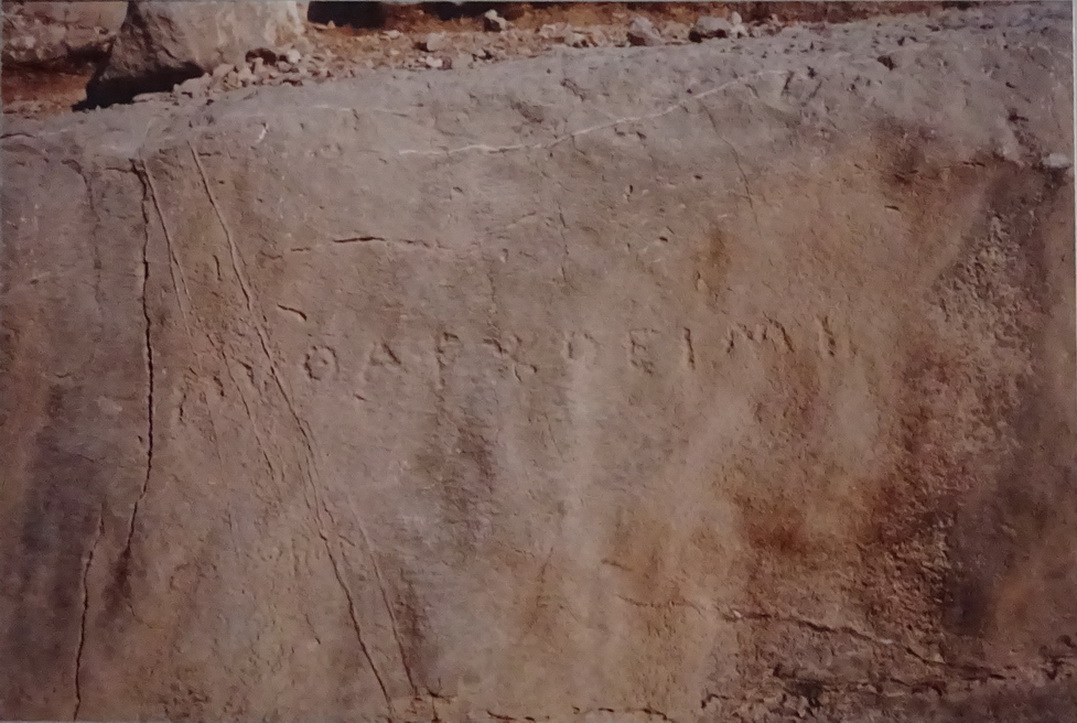
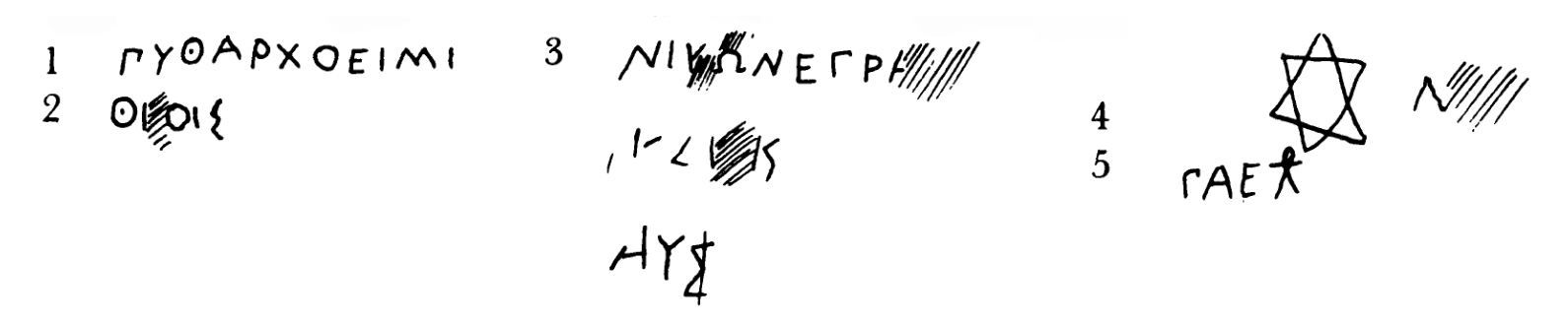
| (a) | Πυθάρχο εἰμί. | I am (the property) of Pytharchus |
| (b) | Θ[.]Ο[.]Σ | |
| (c) | Νίκων ἔγρα̣[φε vel ψε]
Κ[.]ΙΟΣ |
Nicon wrote … |
| (d) | Λ[----]
ΠΑΕ vel ΠΑΒ |
star
monogram(?) |
Inscription Credits
Ancient texts after Rougemont, G. 2012. Inscriptions grecques d'Iran et d'Asie centrale, avec des contributions de Paul Bernard. Corpus Inscriptionum Iranicarum, part II, vol. I.1. London: nos. 55-58. Reproduced by permission of Georges Rougemont and the Corpus Inscriptionum Iranicarum.
Comment
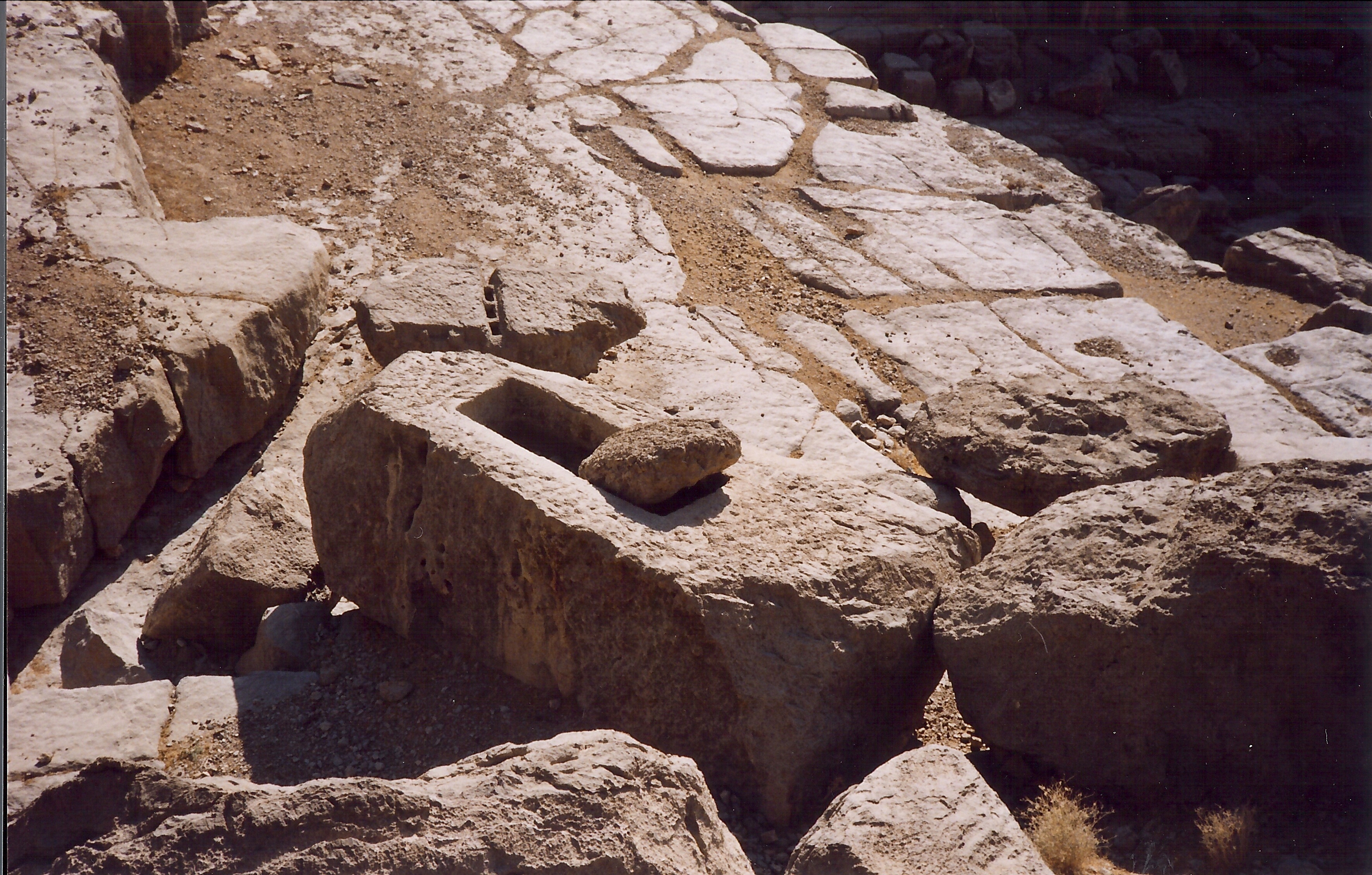
The graffiti were cut into the vertical rock face of a limestone quarry off the northeast corner of the Persepolis platform, at Barzan-e Šomāli (Northern District), on the west slope of Kūh-e Raḥmat, where stone for the construction of Persepolis was extracted. Graffito (b) is carved in much smaller letters beneath (a), and (d) beneath (c). The graffiti were first published by Giovanni Pugliese Carratelli (1966: 31-34, nos. 1-5, with photographs of the quarry, fig. 1, and the graffiti, figs. 2-5 [cf. Lewis 1977: 13; Balcer 1979: 278; Roaf 1980: 70, with drawings of the graffiti after the photographs in Pugliese Carratelli; Calmeyer 1990: 188 n. 16 and 190 n. 26; Huyse 1995: 108]). Additional photographs of graffito (a) and the Persepolis quarries were published by Carl Nylander (1990: 85, 86 fig. 13, 77 fig. 3; see also idem 2006: 133, 125 fig. 3 and 134 fig. 11). For comments on the entire group of graffiti, see further Canali De Rossi 2004: nos. 228, 229, 231, 232 (photographs after Pugliese Carratelli and Nylander); Rougemont 2012: nos. 55-58, pls. 30-31 figs. 55-58 (photographs after Pugliese Caratelli). For graffito (a), see also Guarducci 1974: 378-380, figs. 133-134 (as in Pugliese Carratelli), and Pompeo 2015: 153-155 and fig. 3 (photograph after Pugliese Carratelli); for graffiti (a) and (b), Fornara 1983: no. 46. According to Shahrokh Razmjou, who was able to locate and photograph the graffiti anew in 1998, the two groups of texts (facing south and west, respectively) are situated some 20-30 meters apart, at a 90 degrees angle to and almost level with each other, on the third bench of the quarry slope from the ground. Due also to weathering of the rock, the shallow cuttings are almost invisible today without proper light, even from a distance of one meter. Indeed, as Georges Rougemont (2012: 122) indicates, they had eluded his and his colleagues’ efforts to locate them in 1997.
In inscription (a), the anthroponym, Pytharchus, is typically Ionian (e.g., LGPN, vol. VA, s.v. Πύθαρχος), and the writing has been deemed to be compatible with a date around the end of the sixth century BC (Pugliese Carratelli 1966: 31-32; Rougemont 2012: 123; but see Guarducci 1974: 379 and fig. 134, for a possible dating as late as the end of the fifth century BC). The combination of an anthroponym in possessive genitive case (here expressed with an O ending instead of the digraph OY that eventually became standard) and the first person singular of the verb ‘to be’ —so literally, ‘I am (the property) of Pytharchus’— subscribes to a Greek epigraphic formula for ‘speaking’ objects: that is, a type of inscription on objects that served to identify their owners, and which was perceived as being spoken by the inscribed objects themselves. As there is no indication that graffito (a) was associated with some, no longer surviving, object affixed on the rock face, the ‘speaker’ of the inscription would be, presumably, the quarry face itself (Pugliese Carratelli 1966: 32).
The very few inscriptions of anthroponyms known from Greek quarries are usually interpreted as identifying (head-)quarrymen responsible for supplying cut blocks or, in a rare instance of a name expressed in the genitive case, the lessee or owner of a quarry area (Kozelj 1988: 36-40, pls. 13-15 [Thasos, Chios, Euboea, Athens]; for other published Greek quarry inscriptions, see, e.g., Ober 1981: 68-73 [Mt. Hymettus], Fossey 2014: 321-322 [Eilesion]; Hayward and Pitt 2017 [Cenchreae]). In common opinion, inscription (a) could mean that the ‘quarry bank on which it is carved was the property or preserve of the quarryman Pytharchos’ (wording Roaf; ‘contractor’ or ‘contractor or quarryman’: Pugliese Carratelli 1966: 32, Momigliano 1975: 125, Root 1979: 10, Fornara 1983: no. 46; ‘quarryman’ Rougemont 2012: no. 55 and n. 377).
Inscription (b), barely discernible at present, was restored by Pugliese Carratelli as a consecration, θε̣οῖ̣ς ‘for/to the gods’, but this reading remains hypothetical. Charles Fornara (1983, no. 46) tentatively considered (b) a continuation of inscription (a), instead of a separate graffito. According to different commentators, it could indicate a consecration to the gods of either the entire mountain (Pugliese Carratelli) or just the ‘ownership’ asserted by Pytharchus in inscription (a) (Canali De Rossi), or it could be a votive graffito, left by one of the Greek quarrymen at Persepolis, indicating the veneration of Greek gods locally (Henkelman 2008: 342).
Inscription (c) has been dated on the basis of letter forms to the late sixth or the early fifth century BC (Rougemont; Pugliese Carratelli: first quarter of the fifth century BC). One cannot tell if it was written by a workman at Persepolis or a visitor (cf. Roaf 1980: 70). Only line 1, beginning with the Greek anthroponym Nicon, can be safely restored; Pugliese Carratelli compared it to graffiti left by Greek mercenaries at Abu Simbel (see Meiggs and Lewis 1988, no. 7 c and e, dated to 591 BC). His restoration of line 2 as stating the ethnic, Κ[ε]ῖος (of [the Aegean island of] Ceos) or Κ[ῶ]ιος (of [the Aegean island of] Cos), of Nicon remains hypothetical (Rougemont 2012: 124).
Inscription (d) is badly weathered, and the different readings proposed are, all of them, uncertain (see Rougemont 2012: no. 58). Pugliese Caratelli perceived each of the two lines as a separate graffito (cf. Roaf 1980: 70 nos. 4-5). He rendered the first one (his no. 4) as ‘Λ[----] + star’, comparing the star to a symbol that occurs on the coinage of Asia Minor; and the second one (his no. 5), as ‘ΠΑΒ̣ (or ΠΑΕ̣) followed by a sign that recalls the “symbol of Tanit” ’. He further compared ΠΑΒ̣ with the name Πάβις ὁ ϙολοφόνιος (‘Pavis the Colophonian’) of an inscription at Abu Simbel (see Meiggs and Lewis 1988: no. 7 f, dated to 591 BC; for first century BC and later occurrences of the name that allow an association with Iranian onomastics, see Rougemont 2012: 124 [P. Bernard]). Apparently rejecting the existence of a Λ to the left of the star design, Canali De Rossi (no. 232) considered, in turn, the remainder of (d) a single graffito, consisting of the star (which he interpreted as a Jewish symbol) and the three letters and symbol that are faintly visible below it (here rendered as ΠΑΕ or ΠΑΒ and ‘monogram’). Taking the letter trace that was read as Π by the first editor (and Rougemont) for a Ρ, and the ‘monogram’ (or Pugliese Carratelli’s ‘symbol of Tanit’) for a Λ, he interpreted the whole as a Jewish name, ΡΑΕΛ. From the Jewish tenor of this reading, he postulated that the graffito would have been carved by a Greek stonemason on the behalf of a Jewish quarry worker.
The interpretation of the Greek graffiti of the Kūh-e Raḥmat quarry, in at least three instances, as quarrymen/stone worker inscriptions has been seen to tally with the statement of Darius I in his foundation inscription from Susa that the ‘stone-cutters, who wrought the stone’ for the construction of his palace ‘were Ionians and Sardians (i.e., Lydians)’ (e.g, Kent 1953: DSf 47-49; Schmitt 2009: DSf §13 A-C, DSz §13 A-C), as well as with archaeological evidence for the contribution of the stone working traditions of western Asia Minor to stone working and construction practices at Pasargadae, Persepolis and Susa (e.g., Nylander 2006, Curtis 2005: 115-117, both with further references). One may still keep in mind that explicit evidence for the engagement of Ionian/Greek stone masons/quarrymen at Persepolis in the Achaemenid period is lacking. Diodorus of Sicily refers to a group of Greek laborers brought to Persia by Darius III’s predecessors, who came to meet Alexander III on his approach to Persepolis in 330 BC, without specifying their tasks (Diod. 17.69.3-9; cf. Curt. 5.5.5-24, Just. 11.14.11-12). Allusions to the presence of Ionian/Greek craftsmen among the multiethnic workforce attested at Persepolis are offered by two locally made incised images in archaic Greek style, on a relief fragment from the Palace of Darius and a stone panel, respectively, found on the Persepolis terrace; and ‘Ionians’ are mentioned as wage earners and ration recipients in surviving clay records of the Persepolis administration (e.g., Hallock 1969: PF 1224, PF 2072 ll. 82-86; Cameron 1948: no. 15). A reference in one of the Persepolis Treasury tablets to Syrian, Egyptian, and Ionian workmen at Persepolis as laborers on ‘the iyan’ at the site could imply stone work (Cameron 1948: no. 15, interpreting iyan as ‘columned hall’; but the meaning of iyan is uncertain, e.g., Hallock 1969: 706, s.v. I. iyan ‘court[?]’). In the few instances, however, where the ethnic affiliation of laborers referred to as stone workers is mentioned in the Persepolis administrative tablets, these are identified as Egyptians (e.g., Cameron 1948: no. 9: ‘Egyptians, stone workers, (who) from Egypt came to Parsa, “makers of stone-[... .]” ’; Henkelman 2017: 280-283, NN 0480 and NN 1922; cf. Diod. 1.46.4), Babylonians(?) (Cameron and Gershevitch 1965: 182, PT 1963:20, ll. 4-6) and Carians (Cameron and Gershevitch 1965: 170-171, PT 1963:2, l. 4). (Cf. Boardman 2000: 131-134; for stone working traditions at Persepolis and stone workers, see Roaf 1980; idem 1983: 94-96 and passim; and, more recently, Razmjou 1403/2024-2025, idem, forthcoming, and Zehbari, forthcoming). The presence of Jewish stone workers at Persepolis in early Achaemenid times, as proposed by one commentator in the case of graffito (d), is equally difficult to support, even if other known Hebrew graffiti in the area could speak to such a presence in post-Achaemenid times (e.g., Razmjou 2005: 325-326, Hebrew graffiti at Persepolis ascribed to Sasanian times).
Uncertainties also surround the chronology of the quarry inscriptions. A margin of doubt would apply, in general, to the reliability of dates ascribed to graffiti on the basis, alone, of script. Remains at the quarry, where the Greek graffiti are located, include a half-finished capital that may have been intended for a column of the Unfinished Gate on the Persepolis platform (Schmidt 1953: 57, and 52 and figs. 18 D-E). The date of this edifice is uncertain, but the beginning of its construction (and its abandonment) could belong to the reign of Artaxerxes III or later (cf. Roaf 1983: 158). Given also the generally uncertain possibility of preservation of quarry inscriptions at localities of progressive stone extraction, might one allow that some or all of the Kūh-e Raḥmat graffiti considered here, and currently mostly associated with the early Achaemenid period, could have been carved later (see also Schmitt 2006: 354)? — even after, perhaps, the end of Achaemenid rule and, say, during the time of the subsequent Macedonian-Greek presence at Persepolis? The graffiti’s archaic aspects could, then, still be justifiable, for instance, if they were carved by members of Greek groups relocated to Iran under earlier Achaemenid rulers who, like the Eretrians mentioned by Herodotus (6.119), had kept their ‘ancestral language’, and presumably script, despite developments in writing in their distant Greek homelands.
Bibliography
Balcer, J.M. 1979. ‘Review of J. Hofstetter, Die Griechen in Persien.’ Bibliotheca Orientalis 36: 276-280.
Boardman, J. 2000. Persia and the West: An Archaeological Investigation of the Genesis of Achaemenid Persian Art. London.
Calmeyer, P. 1990. ‘Madjdabad. Zur Datierung von Steinbruch-Arbeiten um Persepolis.’ Archaeologische Mitteilungen aus Iran 23: 185-190.
Cameron, G. G. 1948. Persepolis Treasury Tablets. Oriental Institute Publications 65. Chicago. Also available online at https://isac.uchicago.edu/research/publications/oip/oip-65-persepolis-treasury-tablets
Cameron, G. G. and Gershevitch, I. 1965. ‘New tablets from the Persepolis Treasury.’ Journal of Near Eastern Studies 24: 167-192.
Canali De Rossi, F. 2004. Iscrizioni dello estremo oriente greco. Un repertorio. Inschriften griechischer Städte aus Kleinasien, Band 65. Bonn.
Curtis, J. 2005. ‘Greek influence on Achaemenid art and architecture.’ In Villing, A. (ed.), The Greeks in the East. The British Museum Research Publication Number 157. London: 115–123.
Quintus Curtius (Curt.) = Rolfe, J. C. (trans.) 1946. Quintus Curtius. History of Alexander, vol. II: Books 6-10. Cambridge, MA.
Diodorus Siculus (Diod.) = Oldfather, C. H. (trans.) 1989. Diodorus of Sicily, vols. 4-8. Cambridge, MA, and London. A searchable HTML version with commentary by Perseus Digital Library is available at http://www.perseus.tufts.edu/hopper/text?doc=Perseus:text:1999.01.0084
Fornara, C. 1983. Archaic Times to the End of the Peloponnesian War. 2nd ed. Translated Documents of Greece and Rome 1. Cambridge.
Fossey, J. M. 2014. Epigraphica Boeotica II. Further Studies on Boiotian Inscriptions, with a contribution by Laurence Darmezin. Leiden and Boston.
Guarducci, M. 1974. Epigrafia greca, vol. III. Rome.
Hallock, R.T. 1969. Persepolis Fortifications Tablets. Oriental Institute Publications 92. Chicago. Also available online at https://isac.uchicago.edu/sites/default/files/uploads/shared/docs/oip92.pdf . For the archive’s documents, see also the Persepolis Fortification Archive Project database at the Online Cultural and Historical Research Environment (OCHRE) of the Oriental Institute, University of Chicago, https://isac.uchicago.edu/research/projects/persepolis-fortification-archive
Hayward, C. and Pitt, R. K. 2017. ‘Inscriptions from limestone quarries at Kenchreai, Greece.’ Zeitschrift für Papyrologie und Epigraphik 204: 89-96.
Henkelman, W. F. M. 2008. The Other Gods Who Are. Studies in Elamite-Iranian Acculturation Based on the Persepolis Fortification Texts. Achaemenid History XIV. Leiden.
——. 2017. ‘Egyptians in the Persepolis archives.’ In Wasmuth, M., Ägypto-persische Herrscher- und Herrschaftspräsentation in der Achämenidenzeit. Oriens et Occidens 27. Stuttgart: 276-302, 386-394.
Herodotus (Hdt.) = Godley, A. D. (trans.) 1920. Herodotus, The Histories. Cambridge. A searchable HTML version with commentary by Perseus Digital Library is available at http://www.perseus.tufts.edu/hopper/text?doc=Perseus:text:1999.01.0126
Huyse, P. 1995. ‘Die Begegnung zwischen Hellenen und Iraniern: Griechische epigraphische Zeugnisse von Griechenland bis Pakistan.’ In Reck, C. and Zieme, P. (eds.), Iran und Turfan: Beiträge Berliner Wissenschaftler, Werner Sundermann zum 60. Geburtstag gewidmet. Iranica 2. Wiesbaden: 99-126.
Justin (Just.) = Yardley, J. C. (ed. and trans.) 2024. Justin. Epitome of Pompeius Trogus, vol. I: Books 1–20. Loeb Classical Library 557. Cambridge, MA.
Kent, R. G. 1953. Old Persian. Grammar, Texts, Lexicon. American Oriental Series 33. New Haven, CT. Also available online at https://babel.hathitrust.org/cgi/pt?id=uc1.32106016799493&view=1up&seq=5
Koželj, T. 1988. ‘Les carrieres des époques grecque, romaine et byzantine: techniques et organisation.’ In Fant, J. C. (ed.), Ancient Marble Quarrying and Trade, papers from a Colloquium held at the Annual Meeting of the Archaeological Institute of America, San Antonio, Texas, December 1986. BAR International Series 453. Oxford: 3–80.
Lewis, D. M. 1977. Sparta and Persia. Lectures Delivered at the University of Cincinnati, Autumn 1976, in Memory of Donald W. Bradeen. Cincinnati Classical Studies, n.s. vol. 1. Leiden.
LGPN = Corsten, T. 2010. A Lexicon of Greek Personal Names, vol. VA: Coastal Asia Minor: Pontos to Ionia. Oxford. Also available online at https://www.lgpn.ox.ac.uk/
Meiggs, R. and Lewis, D. 1988. A Selection of Greek Historical Inscriptions to the End of the Fifth Century B.C. Revised edition. Oxford.
Momigliano, A. 1975. Alien Wisdom. The Limits of Hellenization. Cambridge.
Nylander, C. 1990. ‘Considérations sur le travail de la pierre dans la culture perse.’ In Waelkens, M. (ed.), Pierre éternelle du Nil au Rhin. Carriers et prefabrication – Eternal stone, from the Nile to the Rhine. Quarries and prefabrication. Brussels: 73-86.
——. 2006. ‘Stones for Kings: Stone-working in ancient Iran.’ In Callieri, P. (ed.), Architetti, capomastri, artigiani. L’organizzazione dei cantieri e della produzione artistica nell’Asia ellenistica. Studi offerti a Domenico Faccenna nel suo ottantesimo compleanno. IsMEO, Serie Orientale Roma C. Rome: 121–136.
Ober, J. 1981. ‘Rock-cut inscriptions from Mt. Hymettos.’ Hesperia 50: 68-77.
Pompeo, F. 2015. ‘I Greci a Persepoli. Alcune riflessioni sociolinguistiche sulle iscrizioni greche nel mondo iranico.’ In Consani, C. (ed.), Contatto interlinguistico fra presente e passato. Milano: 149–172.
Pugliese Carratelli, G. 1966. ‘Greek Inscriptions of the Middle East.’ East and West 16: 31-36.
Razmjou, Sh. 2005. ‘Ernst Herzfeld and the study of graffiti at Persepolis.’ In Gunter, A. and Hauser, S. R. (eds.), Ernst Herzfeld and the Development of Near Eastern Studies, 1900-1950. Leiden and Boston: 315-344.
——. 1403/2024-2025. ‘Shavāhedi tāze az me'mārān o sangtarāshān-e Pārsi dar Takht-e Jamshid’ [New evidence of Persian architects and stonemasons at Persepolis]. Archaeology (Iranian Centre for Archaeological Research, Tehran) 4(3): 37-51.
——. Forthcoming. ‘Some observations on the final reconstruction of the Great Columned Hall at Persepolis.’ In Nagel, A., Thomalsky, J. and Zehbari, Z. (eds.), Proceedings of the Symposium Working on Stones in the Achaemenid Empire: Methods, Theories and Techniques. Archäologische Mitteilungen aus Iran und Turan 52.
Roaf, M. 1980. ‘Texts about the sculptures and sculptors at Persepolis.’ Iran 18: 65-74. Also available online at https://doi.org/10.2307/4299691
——. 1983. Sculptures and Sculptors at Persepolis. Iran 21. London. Also available online at https://www.jstor.org/stable/pdf/4299731.pdf
Root, M. C. 1979. The King and Kingship in Achaemenid Art. Essays on the Creation of an Iconography of Empire. Acta Iranica 19. Leiden.
Rougemont, G. 2012. Inscriptions grecques d’Iran et d’Asie centrale, avec des contributions de Paul Bernard. Corpus Inscriptionum Iranicarum, part II, vol. I.1. London.
Schmidt, E. F. 1953. Persepolis, vol. I: Structures, Reliefs, Inscriptions. Oriental Institute Publications 68. Chicago. Also available online at https://isac.uchicago.edu/research/publications/oip/oip-68-persepolis-i-structures-reliefs-inscriptions
Schmitt, R. 2006. ‘Griechische Inschriften aus dem “Fernen Osten”.’ Indo-Iranian Journal 49 no. 3/4: 347–359. Also available online at https://www.jstor.org/stable/24664017?seq=1
——. 2009. Die altpersischen Inschriften der Achaimeniden. Wiesbaden.
Zehbari, Z. Forthcoming. A Window into the World of Achaemenid Artistic Specialists. Forthcoming monograph of the unpublished doctoral dissertation: Zehbari, Z. 1398/2019. Barresi-ye Takhassos-hāye Honarmandān-e Gheir-e-Pārsi dar Honar-e Hakhāmaneshi bar Asās-e Madārek-e Bāstānshenākhti va Neveshtāri [Study on the Specializations of the Non-Persian Artists in the Art of the Achaemenid Empire, based on Archaeological and Written Evidence]. University of Tehran.
Cite this entry:
Razmjou, Sh. and Zournatzi, A. 2025. 'Pārseh (Persepolis): Greek graffiti in a Persepolis quarry.' In Mapping Ancient Cultural Encounters: Greeks in Iran ca. 550 BC - ca. AD 650. Online edition, preliminary draft release. Available at http://iranohellenica.eie.gr/content/catalogue/parseh-persepolis/documents/barzan-e-somali/1037538591


Greek graffiti. Kūh-e Raḥmat limestone quarry. Barzan-e Šomāli (‘Northern District’), Pārseh (Persepolis), Fārs province, Iran. Ca. 500 BC? Discovered by the Mission of the Istituto Italiano per il Medio ed Estremo Oriente. Letter dimensions not recorded.