
Mention of an archiereus


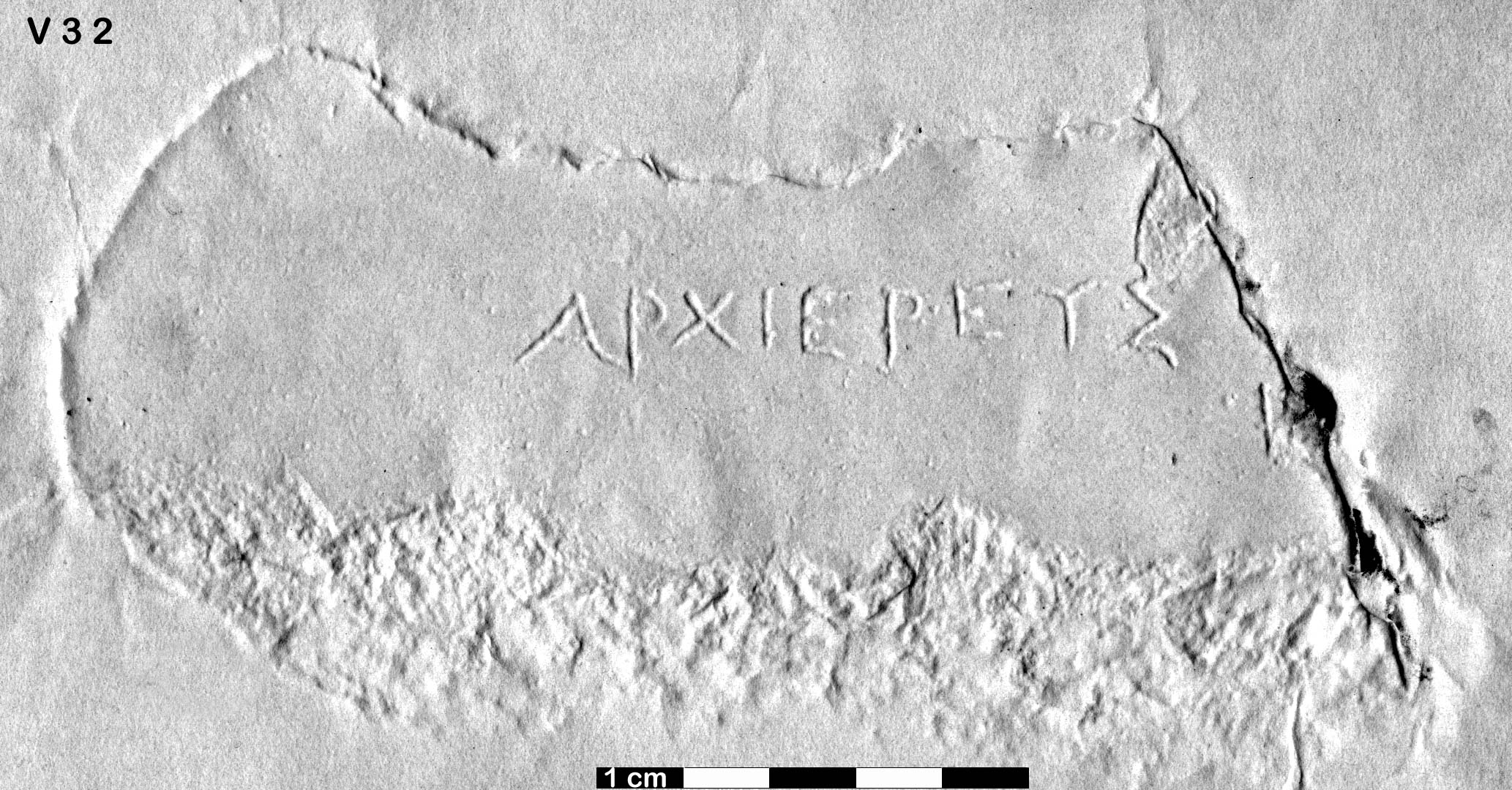
Inscription
ἀρχιερεύς vac. [ ------------ ]
Ε̣[ ----------- ]
Inscription Credits
Ancient Greek text after Rougemont, G. 2012. Inscriptions grecques d'Iran et d'Asie centrale, avec des contributions de Paul Bernard. Corpus Inscriptionum Iranicarum, part II, vol. I.1. London: no. 28. Reproduced by permission of Georges Rougemont and the Corpus Inscriptionum Iranicarum.
Comment
The inscribed fragment was found in the ‘Isthme’ excavation area (location indicated in Martinez-Sève 2002: 46, fig. 6), near the southern tip of the Mound of the ‘Ville Royale’. It was first published by Franz Cumont (1938, with black and white photograph p. 306; see subsequently: Canali De Rossi 2004: no. 181 [photograph after Cumont], Rougemont 2012a: no. 28 and photograph pl. 14, fig. 28, with a detailed description following autopsy, and an inquiry [L. Martinez-Sève] into the archaeological context of the find).
The inscribed surface, and seemingly the sides, of this now mutilated limestone plaque were finely polished. Remains of a reddish-ochre color have been detected in the engraved letters [Louvre]. Only the Greek term archiereus ‘chief priest’ is completely preserved. In the case of the single letter representing a second line of text, the beginnings of the horizontal bars of an epsilon, as observed by Georges Rougemont (and, as he notes, by Jean Pouilloux before him), are not easily discernible in the published photographs and on the squeeze (illustrated here) that was taken by Susan Sherwin-White (cf. Cumont: ‘I’ or, perhaps, ‘E’; Canali De Rossi: ‘I’). In different estimates, the writing ‘could date back to the third century, without ruling out, however, the early second century’ (Rougemont), or to the first half of the second century BC (Cumont).
Cumont (and Canali De Rossi) inclined to an interpretation of the archiereus mentioned in this instance as being most likely one of the ‘grands prêtres du culte officiel des rois de Syrie (i.e., the Seleucids)’. The latter functionnaries are explicitly attested by an edict of Antiochus III (r. 222-187 BC) concerning the institution and organization of religious honors for his consort Laodice in 193 BC, which also mentions archiereis of the king himself and his progonoi ‘(royal) ancestors’ (e.g., Rougemont 2012a: no. 66, ll. 20-26, and no. 68, ll. 5-13).
In Seleucid contexts, archiereis ‘chief priests’ are not uniquely mentioned in connection with the ruler cult (e.g., Müller 2000, Rougemont 2012a: 74, both with further literature). One may recall, for instance, Antiochus III’s formulation of the appointment, in 209 BC, of his loyal ‘Friend’ Nicanor as ἀρχιερέα τῶν ἱερῶν πάντων ‘chief priest of all the sanctuaries’ in the region beyond (i.e., north of) Taurus, as well as ἐπὶ τῶν ἱερῶν καὶ τὰς προσόδους τούτων, that is, superintendent of the sanctuaries and responsible for their sacred revenues ([PHI]; Ma 1999: 288-292, document no. 4, ll. 29-41, and pp. 26-28, arguing for the different character of the appointments as ‘chief priest of all the sanctuaries’ and ‘chief priest of the ruler cult’; cf. Capdetrey 2007: 323-327; but see also, e.g., Müller 2000, Van Nuffelen 2004, for a possible lack of a clear separation). In yet another instance, dated to 189 BC, the appointment of another ‘Friend’ of Antiochus III as archiereus of Apollo and Artemis Daittai and the other sanctuaries in the Seleucid religious center of Daphne (Dittenberger 1903: no. 244; Jalabert and Mouterde 1953: no. 992; Welles 1934: no. 44; [PHI]) may be broadly referred to, once again, to authority over the local priests of these sanctuaries and, presumably also, the administration of these sanctuaries’ income. The archiereus mentioned in the present fragment could have been ‘in charge of the celebration of the ruler cult, the finances of the sanctuaries, or their general management’ (cf. Martinez-Sève 2015).
Certain Parthian period references in the Babylonian Astronomical Diaries led Yasuyuki Mitsuma to speculate that the office of ‘chief priest of all the sanctuaries’ -as it related to the financial administration of the temples- was installed by the Seleucids in the Upper Satrapies as well, and was perpetuated under the Arsacids (Mitsuma 2005; Spek et al. 2025: Diary -129A2: 21΄ and p. 653, and Diary -72: 10΄ and p. 860).
In the Greek epigraphic corpus from Iran, a further reference to an archiereus might be alluded to by the phrase ‘of all the sanctuaries’ ([τ]ῶν ἱερῶν πάντω̣[ν]) in a highly fragmentary inscription found at Ayvān-e Karḵa, but probably originating, like the present inscription, from Susa (Rougemont 2012b: 27 n. 107; Coloru and Shabani 2026).
Bibliography
Canali De Rossi, F. 2004. Iscrizioni dello estremo oriente greco: un repertorio. Inschriften griechischer Städte aus Kleinasien 65. Bonn.
Capdetrey, L. 2007. Le pouvoir séleucide: territoire, administration, finances d’un royaume hellénistique (312-129 avant J.-C.). Rennes.
Coloru, O. and Shabani, M. 2026. ‘Ayvān-e Karḵa: An honorary decree from Susa?’ In Mapping Ancient Cultural Encounters: Greeks in Iran ca. 550 BC - ca. AD 650. Online edition, preliminary draft release. Available at https://iranohellenica.eie.gr/content/catalogue/ayvan-e-karka/documents/1801439403
Cumont, F. 1938. ‘Une brève inscription grecque de Suse.’ Comptes rendus des séances de l'Académie des Inscriptions et Belles-Lettres 82.4: 305-307. Also available online at www.persee.fr/doc/crai_0065-0536_1938_num_82_4_77058
Dittenberger, W. 1903. Orientis Graeci Inscriptiones Selectae, vol. I. Leipzig. Also available online at https://archive.org/details/orientisgraeciin01dittuoft/page/n6/mode/1up
Jalabert, L. and Mouterde, R. 1953. Inscriptions grecques et latines de la Syrie, vol. III, 2: Antioche, Antiochène. Paris. Also available online at www.persee.fr/doc/bah_0768-2506_1953_cat_51_32
Louvre = Louvre Collections database online. Accessible at https://collections.louvre.fr/en/
Ma, J. 1999. Antiochos III and the Cities of Western Asia Minor. Oxford University Press, Oxford.
Martinez-Sève, L. 2002. ‘La ville de Suse à l’époque hellénistique.’ Revue archéologique 33: 31-53. Also available online at https://doi.org/10.3917/arch.021.0031
——. 2015. ‘Susa iv. The Hellenistic and Parthian Periods.’ Encyclopaedia Iranica. Published May 8, 2015. Accessible at https://www.iranicaonline.org/articles/susa-iv-hellenistic-parthian-periods/
Mitsuma, Y. 2005. ‘Office of rab kumarī.’ Nabu 2005-80. Accessible online at http://www.achemenet.com/pdf/nabu/Nabu2005-080.pdf
Müller, H. 2000. ‘Der hellenistische Archiereus.’ Chiron 30: 519-542.
PHI = Packard Humanities Institute Greek Epigraphy database. Accessible online at https://inscriptions.packhum.org/
Rougemont, G. 2012a. Inscriptions grecques d’Iran et d’Asie centrale, avec des contributions de Paul Bernard. Corpus Inscriptionum Iranicarum part II, vol. I.1. London.
——. 2012b. ‘Les inscriptions grecques d’Iran et d’Asie centrale: bilinguismes, interférences culturelles, colonisation.’ Journal des savants janvier-juin: 3-27.
Van Nuffelen, P. 2004. ‘Le culte royal de l'empire des Séleucides: une réinterprétation.’ Historia 53: 278-301.
Cite this entry:
Zournatzi, A. 2026. 'Šuš (Susa): Mention of an archiereus.' In Mapping Ancient Cultural Encounters: Greeks in Iran ca. 550 BC - ca. AD 650. Online edition, preliminary draft release. Available at http://iranohellenica.eie.gr/content/catalogue/sus-susa/documents/807433087


Fragment of a limestone plaque preserving a mention of an archiereus ‘chief priest’. Hellenistic period (third century or first half of the second century BC). Mound of the ‘Ville Royale’ (Area ‘Isthme’). Šuš (Susa), Ḵūzestān province, Iran. Excavations of R. de Mecquenem (Mission archéologique de Susiane), 1938. Louvre, Sb 18589 (also no. V 32). H. 0.10 m, L. 0.18 m, Th. 0.055 m. Letters H. 0.005-0.01 m.